
Will Katerberg and Rachael Copelin
During our last conversation, Will, you described some key components of your early journey as a historian. You also mentioned that students will discover an inclination, or “thing,” something essential about themselves, that they are likely to carry with them from job to job throughout their career. You’ve identified yours as storytelling. I’d love to hear more about your professional journey and how your “thing” has been a consistent thread through it all as well as how it has evolved over time.
1. You’ve done a variety of jobs at Calvin that eventually led you to your current role as curator of the archives. Can you say something about how that happened and how you adapted to new roles?
I’d never really considered doing any kind of administrative work as part of my career. Two experiences changed my mind about that in 2006. The first was that towards the end of my sabbatical in 2006, after seven months of research and writing, I realized that I was bored and was looking forward to getting back into the classroom. I was kind of shocked by that. At some point I had come to enjoy teaching much more than I had realized, and I was missing it. The second was that in the fall of that year I began a five-year stint as editor of an academic journal, Fides et Historia (faith and history). I was not a job that I sought, but there was need for someone to do it, and the board of the Conference on Faith and History and my colleagues at Calvin cajoled a reluctant me into doing it.
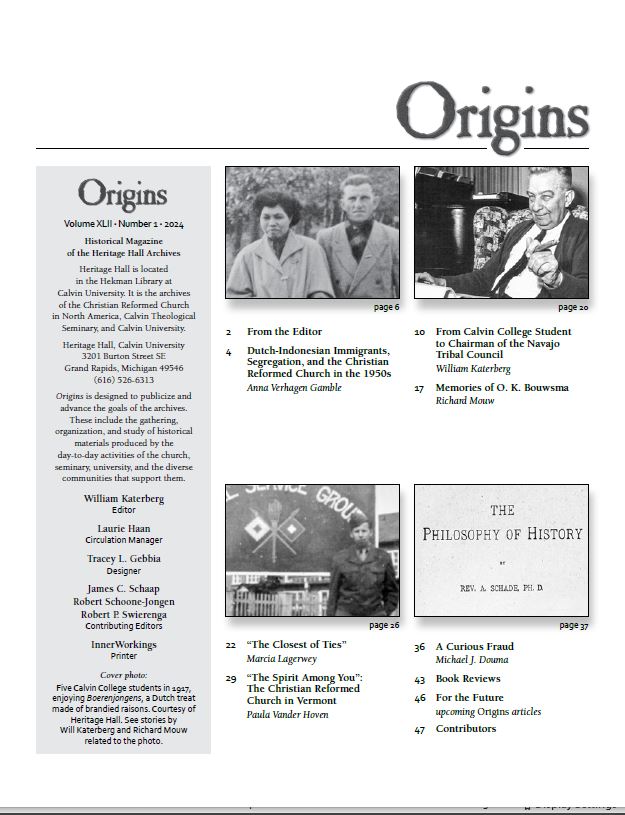
I quickly discovered that I loved editing and was good at it. Part of it was that I simply liked the work, intellectually, in helping someone develop a project that had potential and get it to the point where it was ready for publication. The deeper part was realizing how much I enjoyed mentoring graduate students and young faculty (I was only 40 myself at the time), and occasionally mentoring a more senior scholar who had mostly been a teacher and had done little publishing. I enjoyed helping others write a good essay as much or more than successfully publishing my own writing. I ended up editing a book series too, for a publisher.
Realizing how much I enjoyed teaching and mentoring also led me to seek out administrative opportunities in the decade after I finished my time as editor of Fides in 2011. I served as department chair in history and then in communication and at the same time was an associate dean in the provost office. Late in the 2010s, the provost asked me to step in as part-time curator of the archives. The position had been vacant for a year, but they were not ready yet to hire a person full time. So, I was simultaneously co-chair in communication, associate dean in the provost office, curator of the archives, and still teaching one course a year as a professor of history. People never knew where to find me, as I literally had four offices to go with my four titles.
I did not originally intend to apply for the full-time position as curator, but after enough people who knew me well asked me if I was going to apply, I reconsidered and did. Even then, it was a bit of a lark, as I did not really expect to get the job. I wrote my application as much to suggest to the committee what the archives most needed going forward, and I realized I fit the bill better than I expected and that I was intrigued by the idea. And then I ended up getting the job. I joke with students who ask me how you become an archivist, saying that you don’t try to become an archivist for 30 years, never imagine doing it, try to avoid it when someone suggests the idea to you, and then to your surprise you become one.
2. You have said that serendipity and curiosity as much as anything led you to these new roles. When and how did you realize that for you it was storytelling that linked them all together?
I realized it in stages, I think. The first was practical. As I took on new administrative roles, I had to figure out how to do new kinds of work. That included developing new programs, helping build or maintain partnerships, write reports on various issues, do investigations. Whenever I felt overwhelmed, I would break down the process and end goal and approach them as if I were researching and writing a history project. In other words, I took something that I was already good at and had a lot of experience doing and adapted my work process to a new kind of work. I also was asked a couple of times to lead a workshop on how curiosity is a valuable component of being an administrator. When I was asked to do this, I asked why they asked me. They laughed and told me how much I talk about curiosity, use the word, and demonstrate curiosity in committees and my own administrative work.
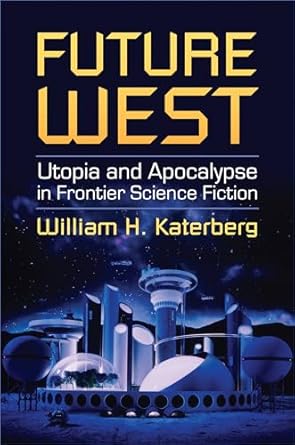
The second was a conversation with one of my profs from grad school. In the 2010s, a few years before he passed away, we were talking about careers. He told me in his folksy way that I was more of a prospector than a miner. Rather than sticking to one spot and digging there, I’d find something, check it out for a while, and then move onto another spot, curious to find something else. I’ve published essays and books in North American religious history, political history, the American West, and more, and published outside of history in social theory and film and literary criticism. I’ve done the same with my administrative work. Trying out different things as a matter of curiosity as much as for any other reason. Same with teaching, when asked to do something. “Why not? Sounds fun.” And I’ve lucked into opportunities, saying yes “just to see” what it’s like and whether I’ll enjoy it and be able do it.
The third was more personal and reflective. When I applied for the full-time archivist job, I emphasized that what was most needed at the moment in the curator role in Heritage Hall Archives was someone who could tell the stories of the institutions and communities associated with the Archives, in an era of change. And I realized that I suited what was needed, and it fit me.
3. If you figured this out in retrospect, what do you recommend for students as they decide what their career will be? Won’t they, like you, figure out their “thing” in retrospect?
It’s easy to see your path in retrospect, both all the serendipitous opportunities and the logic behind the ones you’ve seized. It’s part of getting older and learning more about yourself and listening to colleagues and your own mentors and what they’ve observed in you. When I did the workshops on curiosity, some of the participants laughingly asked me, “Do you realize how often in a meeting you’re listening, observing, and then you cock your head, pause, and say something like, ‘I’m curious . . . ,” and then make an observation about the conversation or ask a question?” They were right. I started catching myself doing it. Sometimes, my curiosity goes nowhere. But on occasion it has re-directed a conversation and taken the committee’s work down a different path than we intended. That’s why I was asked to do the workshop. Curiosity sometimes is a luxury you don’t have time to follow. Sometimes it’s a necessity, as going in a different direction leads you to a much better solution or opportunity than the one you originally intended.
So, what I tell students is to have a plan, a goal, and do what it takes to get there. But along the way, be open to the nagging question, the intriguing side-tracks, the interesting thing that keeps coming up, and be open to trying out something you did not intend. Put that something on the back burner, maybe, keep it simmering. (Studying the American West thing was unexpected for me in grad school, and it ended up on my back burner for a few years. But having that on my back burner is what ended up getting me hired in the history department at Calvin.)
Be open to taking the occasional risk or accept an unwanted opportunity, and be self-aware about how you’re evolving as a person and open to the idea you’re not the quite same person you thought you were. That’s a good thing to do when you’re researching a history paper. Listen to the evidence. Be open to what your professor or editor or anonymous reviewer suggests and be open to changing what you think your topic or driving question or thesis is. When I was halfway through my dissertation, I realized I had been asking the wrong question. I finished the dissertation with the original question, but already knew how I’d transform it when I turned it into a book. When I published my first essay, one of the anonymous reviews observed something about what I was doing in the paper. What that reviewer thought I was doing was much more interesting than what I had thought I was doing. So being open to following your nose. A good lesson for history papers; it’s also a good way to approach your career and life.
4. Any final thoughts?
In the long run, to succeed in a variety of jobs and perhaps a variety of careers, people need to do things they love, things that allow them to flourish as people, things that also serve the organizations they work for, the people they work with, and their clients. All areas of work have aspects that are a grind. Even doing things you love will be a grind some days. But hopefully, more often than not, a person’s work is mostly not a mere grind but something they. Every job I’ve had included things where I thought, “That’s why they have to pay me to do this,” and things that in retirement I’d continue to do for free—because it’s part of who and what I am and what I love to do.
***
Thanks, Will, for sharing your story and insight. For those of you reading this post, what’s your “thing”? What are you curious about, what do you enjoy doing, what are you good at, what do you love? How you answer those questions now and how those answers evolve over time will lead you on a journey you may have never expected. But a remarkable journey nonetheless.
William Katerberg is a professor of history and Director of the Mellema Program in Western American Studies at Calvin University. He is also the curator of Heritage Hall, the archives for Calvin University, Calvin Theological Seminary, and the Christian Reformed Church in North America. Finally, he is the editor of Origins, the blog and magazine published by Heritage Hall.

 Historical Horizons