
Eric M. Washington & Sherita M. Washington

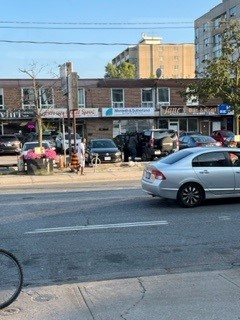
Eglinton Ave West was a bit dusty at dusk on this beautiful early August evening. We were on our honeymoon, and having a wonderful day having spent a portion of it high in the Toronto sky in the CN Tower. After a longer-than-expected subway ride, we were enjoying the weather and soaking in the landscape of grocery stores, restaurants and bars, storefront churches, and ubiquitous barber shops.
“I cannot believe how many barbershops they had,” Sherita said a few hours later after we returned to our hotel. Eric counted at least ten, but Sherita said there were more than that in about an eight-block stretch on both sides of Eglinton Ave West. This was the scene in Little Jamaica, a collection of west end neighborhoods in Toronto. As its name indicates, this neighborhood is home to generations of Jamaican Canadians who have preserved much of their culture to fit within an overall diverse culture in Toronto. Other folk from the Caribbean call it home as well as various people from Asia, the Pacific Islands, and the Middle East. Though the neighborhood is ethnically diverse, it is the bastion of Caribbean Toronto.
In a 2022 article published in National Geographic, storyteller and traveler Heather Greenwood Davis, who is from Little Jamaica, states that there are nearly 350,000 persons of Caribbean descent in Toronto, which is 12% of the city’s population. Though Caribbean people have lived in Toronto since the early 20th century, the first significant wave of Caribbean immigration occurred during the 1950s and 1960s as a result of the West Indian Domestic Scheme, which was an initiative to attract women to work as domestic servants in post-war Canada according to the Government of Canada. Very similar to the United Kingdom’s strategy to attract Caribbean people to immigrate to work to rebuild their post-war economy, Canada’s program resulted in tens of thousands of immigrants from the Caribbean landing in the country, mostly in urban locales such as Toronto.
In Eric’s teaching of African Diaspora history, he introduces his students to a social concept called “circulatoriness.” Developed by sociologist Ruth Sims Hamilton, circulatoriness refers to the historic and contemporary movement of African peoples in the west. Beginning with the Transatlantic Slave Trade, persons of African descent have been forcibly dislocated through slavery and then post-slavery have immigrated to find better employment in the western world. Though they immigrated to western metropolises like New York, London, and Toronto, their cultures have heavily accented these places and have come to characterize them.
While in Little Jamaica, we noticed the abundance of barber shops and beauty shops. Though there were some businesses that had closed (noticed by empty and gloomy storefronts), the barber shops were all open and bustling to various degrees on this Friday evening. Though one can argue that churches are the hub of African Diasporic communities in the west, it may well be that barber shops and beauty shops serve a more vital purpose in acculturation. By simply walking past these shops and taking quick observational mental notes, we saw that each shop had its own unique style and clientele. It was the barber shop though that dominated the scene on Eglinton Ave West. Some had televisions on while others played music. We noticed the shops brought a sense of community where men could laugh and enjoy themselves while getting fresh fades and line-ups for the weekend. These shops exuded a brotherhood that extended beyond a mere haircut. These were small centers of camaraderie and sharing. We were unable to assess the beauty shops because they were less open in terms of having doors wide open and loud voices echoing from their insides.
Though we felt a vibrancy in Eglinton West, scholars and journalists have noted that Little Jamaica has experienced disinvestment and an economic downturn in the 1990s in which the community has never recovered. Owing to this disinvestment, the community’s vibrancy has been waning in recent years. Graphic designer Debbie Gordon argues that Eglinton West has suffered owing to erasure. For Gordon this erasure has come in the form of Black businesses being “replaced” or “displaced” by “Light Rail Transit stations” and an attempt to redesign the area that transforms its historic visual design that counters its cultural aesthetic. We noticed some empty shells that were once business locations. The economic recession affected not only the flourishing of businesses, but home ownership as well. Learning this caused us to see this as a pattern of Black displacement, which has occurred in North America historically. In her 2022 novel Junie Black Canadian novelist and writer Chelene Knight has written about the now defunct Hogan’s Alley in Vancouver, which was once a lively Black neighborhood.

After an extra-long subway ride (we took Line 1 the wrong way! It was Eric’s fault) and a nice walk along Eglinton Ave West, we decided to drop in to one of the many eateries for some Down Home Caribbean food. We found just that at Sheryl’s Caribbean Cuisine. Eric had viewed the restaurant’s website and knew that it was a popular place in Little Jamaica. There is nothing eye-catching about the place. There are a few tables, and there are a few bar stools nestled in front of a table bar that looks out onto Eglinton Ave West from the wide storefront window. According to the website, the owners are from Clarendon Parish, Jamaica, which is on the southern coast of the island country. The food did not disappoint; in fact, it was better than any Jamaican food we’ve had in the States. The Stew peas and Callaloo were outstanding. For Eric, the Stew peas (in Jamaican cuisine “peas” are red beans) tasted just like New Orleans-style Red beans, which further signified that the African Diaspora is real!
When a historian and a social worker go on Honeymoon, they take notice of culture and its resilience, what has changed and is changing, what has caused the change, and how people live in a community undergoing change. This was not lost on us as we explored Little Jamaica. There are marks of gentrification in the neighborhood such as a new apartment complex and the subway station that is undergoing a makeover along the Eglinton Ave West. As mentioned above, some businesses have shuttered up. Yet the barber and beauty shops, the restaurants, and the churches remain. These are enduring institutions that sustain culture and mark a persevering culture. As spatial changes persist in the neighborhood, it’s important for visitors to experience this neighborhood as we did.
Eric Michael Washington is professor of history and director of Africana Studies at Calvin University. He is primarily interested in studying the African American church from its development in the late 18th century through the 19th century, and individual Christians, primarily Calvinists. He also has a growing academic interest in the growing “Black and Reformed” movement in North America
Sherita M. Washington is visiting assistant professor in social work at Calvin University.

 Historical Horizons